Life in the Times of Coronavirus: Lockdown Day 30
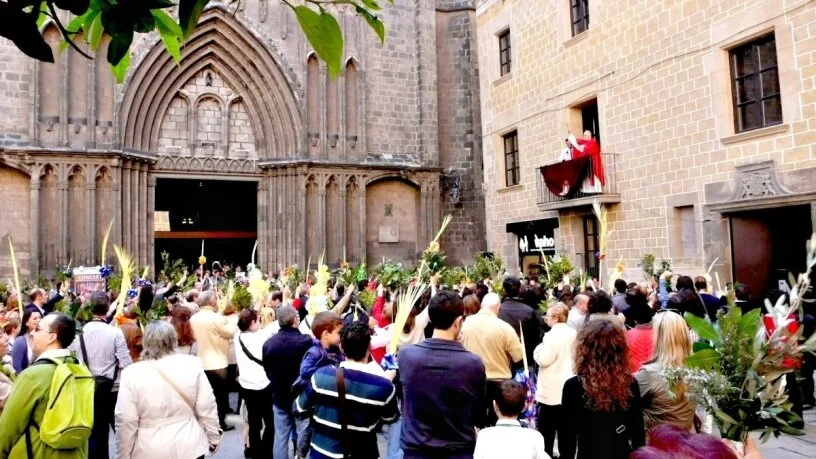
La Burreta.
Today is Easter Sunday. After living in a largely Catholic country for nearly 10 years, I’ve come to recognize the traditional hallmarks of Holy Week in Catalonia. On Palm Sunday, there is a procession through the Gothic Quarter in Barcelona called La Burreta (“Little Donkey”) which commemorates Christ’s entry to Jerusalem. Deep-fried dough balls called bunyols are stacked high at every bakery in sight. On Good Friday, the Sant Martí church in Cerdanyola march in solemn procession through the streets of our town, images of Christ and the Virgin Mary resting on the shoulders devotees. The nazarenos, instantly recognizable because of their pointed capirotes (reminiscent of a particular American hate group), accompany the elderly señoras wearing veils and mantillas and the priests blessing the crowds, some of whom cry out for mercy to the passing crucified Jesus. And, of course, Easter Sunday means long lunches with the entire family.
This year, with the coronavirus pandemic still in full swing, I hadn’t remembered that today was Easter Sunday. Much like the days which bleed indistinctly into each other so much that Wednesdays feel very much like Saturdays, there was no way one could tell that it was Holy Week. I woke earlier than usual today and it wasn’t until I switched on the television and saw that Easter Mass was being broadcast from the Benedictine Abbey in Montserrat that I remembered that today was an important religious holiday for believers. The camera zoomed out to show empty pews and the few priests and bishops in attendance were seated the requisite two meters apart. Even the House of God was not exempt from the guidelines recommended by the Spanish health authorities.
I poured myself a second cup of coffee and stood at the window. On the television, the priest was praying for all those stricken with or who had died from the coronavirus; he crossed himself and the assembled clergy chanted Amén. The priest readjusted the sleeves of his white cassock before he blessed the host and wine and then reminded everyone to find hope in the idea of the crucifixion. Because Christ had indeed died, but he rose after three days, perhaps on a Sunday very much like this one. He is Risen, the priest said. Amén, repeated the clergy. I couldn’t help noticing that one especially old friar was nodding off, his chin resting peacefully on his chest, his gold-rimmed glasses just starting to slip from his nose.
I’ve always been fascinated by the stories that we tell about death and mortality. Whether it’s Orpheus braving the underworld to rescue Eurydice or Persephone being forced to live alongside Hades or Odysseus offering sacrifices to the hungry spirits; whether it’s Lazarus or Christ himself being brought back from the forbidden country of the dead; or whether it’s the elderly Úrsula Iguarán finally giving up the ghost in One Hundred Years of Solitude, death is not a topic from which I shy away. Yes, it’s an uncomfortable topic, but since it’s ultimately something that all of us will face one day, it only makes sense (in my mind, at least) to contemplate it and, in essence, to prepare oneself for that ultimate transition.
I owe this awareness and respect for death to my upbringing. Growing up in a religious household, God and death were always present: the former was there to protect and to punish; the latter served as the final, sacred conduit back to heaven itself. When I was a child, my parents never sugarcoated death, never tried to mollify the gravitas that is inherent to mortality. I even recall my mother discussing her own death multiple times when I was a child. One day, when I’m gone, you’ll remember today, she’d tell us. Or, Bring me flowers now that I’m around to see them. What good will they be once I can no longer see them? I used to be terrified at the thought and remember waking one more than one long summer night to rush to my parents’ bed to make sure that she was still breathing.
This may seem morbid to some, but for me at least, becoming aware of the inescapable truth that my mother—and by extension, other loved ones—will one day embark on that final trek filled me with the urge to record as much as I could of the life I was living, because one day those memories preserved in words would be the only part left of the people I’ve so deeply, deeply loved. This set the patterns of thinking into motion which would lay the foundation for me to become a writer. The passing of time became the urgency that would drive my creative development for the rest of my life.
Death, then, was not a foreign topic to me. In fact, I actually remember one of my first experiences with death. Godparents and puppies and family friends had passed on when I was still in elementary school, but it wasn’t until sixth grade when a classmate died that I was forced to really confront the idea of mortality, as well as to behold the terrible realization of my own death.
It was the spring of 1993 and I had just turned 11. I was in the sixth grade and would begin middle school along with my classmates that fall. Among my schoolmates was a pair of fraternal twins, J. and his sister S. I wasn’t close to either sibling, but remember J. as being prone to rough play, wrestling and sports much like other boys his age. Being nerdy and shy and insecure, I spent more time with girls and signed up for music and art classes. I have flashes of being in music class with S. because I distinctly recall that she was a huge fan of rap music and once challenged our teacher to name at least ten hip hop songs.
Despite the pass of 27 years, I also distinctly remember her sharp green eyes which would stare at you inquisitively, as if she were constantly evaluating what you were saying to see if you were telling the truth. Whereas her brother J. had his head cropped short and dressed like a cholo (white tank top, blue cargo shorts worn past his knee), S. had long curly hair which she often tied in a bun on her head. I can still remember her raspy voice, the splash of freckles under each eye, her skinny frame dancing forever in the sunlit playground of my memories.
We all started middle school that fall and neither J. nor S. were to be seen anywhere. We all knew they came from a troubled home—the father was in jail and the mother was largely absent—so we at first assumed that they had moved out of town. But about two weeks after the school year started, J. appeared by himself in the school’s crowded corridors. The once athletic and outgoing young man had withered into a gaunt figure so thin that you could see his ribs poking out from beneath his tank top. I don’t know how I found out that over the summer, J. had accidentally shot his sister S. with a pistol that belonged to his mother’s boyfriend.
I don’t know the details of that tragic event. I just remember walking home in a daze, unable to believe that my smiling and raspy-voiced friend was now lying in a coffin in our town’s cemetery. I beat back images of her rotting body, of her wailing mother, of her brother who would be saddled with guilt for the rest of his life and soon started running home instead.
And before me there opened up the abyss of my own mortality. I’d heard people compare death to sleep at that point, and at picturing that dreamless slumber—one where I would simply stop existing, unfeeling of rain or rage—I had the sensation of peering down into an unfeeling bottomless chasm which would one day swallow me whole. I cannot adequately express the fear I felt on that day, a fear which I knew was universal and which I also knew was, in some way, one of the sacred truths of life.
The following year, the fires of this realization were stirred again when a cheerful Cuban woman that my parents had known ever since they arrived in the United States, died of diabetes-related complications in her early seventies. But I do remember her very vividly, as she also helped raise me when I was very young. I distinctly remember her tickling me, offering me Cuban crackers smeared with butter, and the moka pot’s aluminum top vibrating with the brewing coffee. I also remember once when, after swallowing some chewing gum, she gave me several teaspoons of castor oil and the rubbed my left calf with some to massage out the gum. I also remember her dark-skinned (and never-faithful) husband, Don Luis, who she referred to—sometimes lovingly, sometimes as an insult—as El negro.
When she died in 1994, I was not allowed to attend the wake or funeral and never saw her body. But I do remember this: my mother, sitting in her bedroom, crying into a black knit sweater. I sat down next to my mother and tried to comfort her and asked her why she was holding that particular sweater. She told me it belonged to Olga and that it still smelled like her pungent perfume that was instantly recognizable. My mother drank deeply of the fragrance and offered it to me to smell also. I took a whiff, conjuring up an image of Olga rocking in her chair as the sunset, calling out to us kids to be careful and to look before we crossed the street. And I also recall being taken aback by my mother’s decision to keep Olga’s sweater as a keepsake, as a way to hold onto her memory. If I had previously learned the importance of recording our memories, it was in that moment that I also learned how.
Given all this, it is perhaps not surprising that, wherever I travel, I make it a point to visit a cemetery. I wander around the gravestones looking at the dates of birth and death and mentally calculating ages. I gaze into the eyes of the pictures that are on some tombstones and dust off the graves of some that look neglected. As I walk in the city of the dead, I meditate on the fortune of the living.
When I first moved to Barcelona, one of the first places I visited was the Poblenou cemetery. Rebuilt on top of the old cemetery that Napoleon’s troops destroyed in 1775, most of the graves date back to 1819 and extend all the way to our present day. And, like lots of other Spanish cemeteries that I’ve seen, the dead, much like the living, are stacked on top of each other.
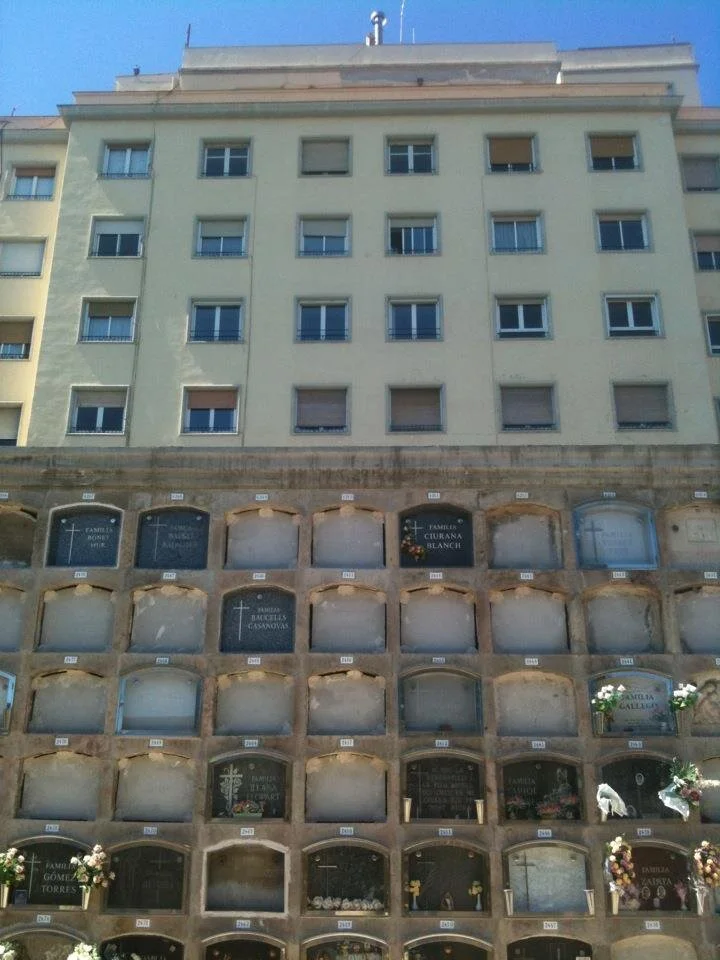
The graves of the Poblenou cemetery.
The cemetery is also full of different sculptures like the famous Petó de la mort (Kiss of Death) by Jaume Barba.
But what initially attracted me the most to this cemetery in particular was the legend of one if its most celebrated residents, El Santet, which literally means “the Little Saint.” Born Francesc Canals I Ambrós in Barcelona, he died in 1899 at age 22, most likely from tuberculosis. Though not much is known about his life, we do know that he was much loved by his contemporaries, and that people up to this day leave notes and other offerings at his grave to ask for his intervention in their worldly worries.
When I first visited the grave of El Santet back in May 2012, I was surprised to see that there was no one there. In fact, there was only a seagull which flew from one row of tombs to another, following me. I had written a simple message on a piece of paper asking for El Santet to watch over my family and me and was trying to find his grave when suddenly I spotted it. Crowded with notes and bright flowers, it was the only spot in the entire cemetery that had a bit of color.
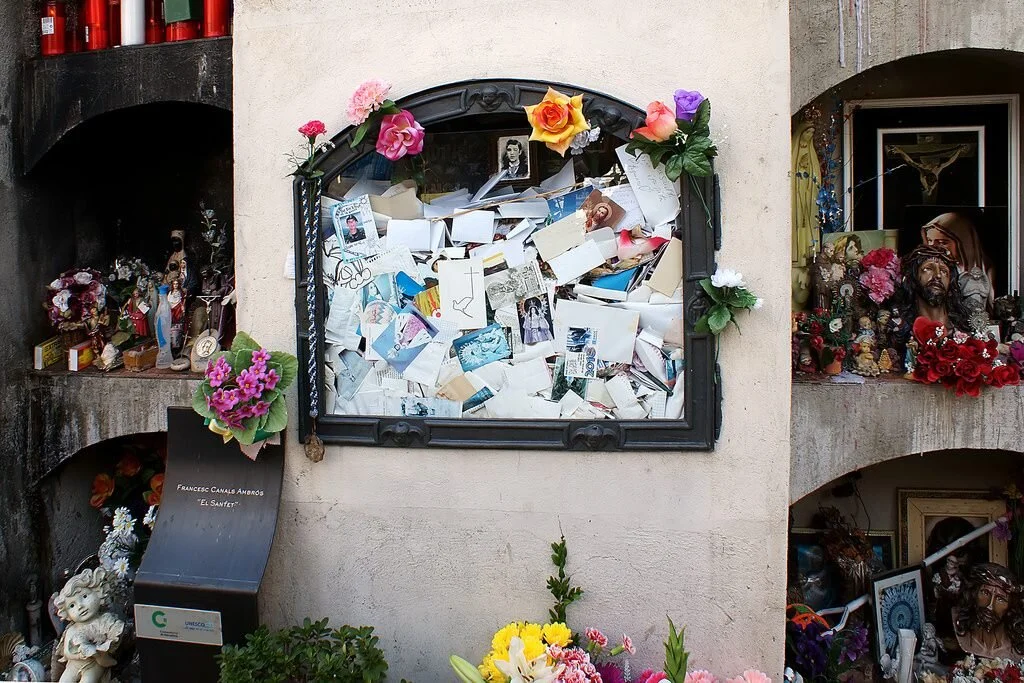
The grave of El Santet.
I gingerly slipped my note in the small opening and stood back to think. I looked at the simple grave and at the eager offerings left behind by devotees. Some implored for him to cure their stage 4 cancer, another to heal a granddaughter of leukemia. Another note begged for better luck in a relationship and another asked for help with a crippling case of schizophrenia. Pictures of children and newborns. Amid so many sincere pleas for help, I couldn’t help feeling as if I were in a holy space and asked out loud for protection, for benediction, for faith.
Today, on this Easter Sunday, and amid so much pain and strife in Spain and the world because of the coronavirus pandemic, I find myself turning back to the memory I have of visiting the Poblenou cemetery. Especially now, we must steel ourselves to the sobering reality of death, which only helps to underscore the very real miracle of life. Life, like the concept of resurrection, by definition cannot exist without death. It is up to all of us to decide how we wish to commemorate and honor those who have embarked on that final journey before us. Though a book will never take the place of a person I loved deeply, words, on some level at least, will need to suffice in order to resurrect their memory.