Life in the Times of Coronavirus: Lockdown Day 31
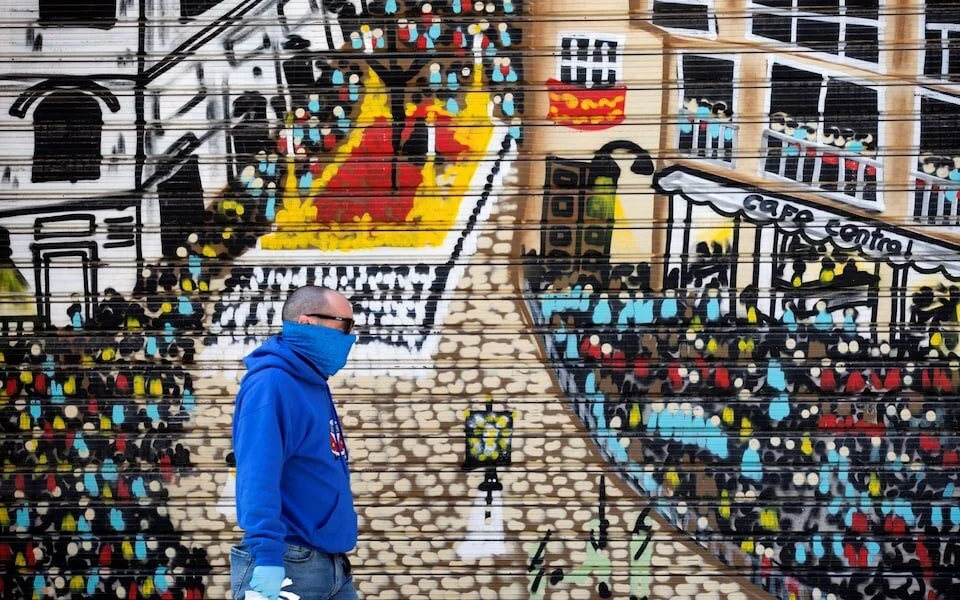
Despite some stern warnings from the scientific community—and the fact that as of today there have been nearly 170,000 confirmed cases of coronavirus (nearly 65,000 of whom have recovered)—workers in Spain deemed “nonessential” can return to their jobs starting today.
As is the case in a lot of countries, though, we are having trouble receiving a unified, consistent message. In the space of three days, we’ve received conflicting news: first, that the complete confinement would last until mid-May at the least; then, that “some” workers would be allowed to return to work; yesterday, the government seemed to suggest that folks should instead remain at home. Today, workers whose jobs are deemed non-essential—the list is long and includes everything from hairstylists, smoke shops, construction work and gas stations—returned to their jobs today.
Local authorities have also started handing out masks at metro stops and railway stations and are still enforcing social distancing on public transport.
Most of us here are a bit confused today. I’ve received text messages from fellow expats asking me to translate a given news article or important email that they’ve received from their companies, most of whom aren’t sure if they need to open or not.
We are also generally unsure about how wise it is to start lifting strict restrictions that have been in place for a month now. While it’s true that the number of infections have been dropping, a number of scientists have warned about a potential second wave and increase in the number of cases if the measures are relaxed too soon.
One expert is Dr. Antoni Trillas who, in an article published last Friday (as the measures were being debated by the central government), warned of the potential problems that may arise if people return to work too soon. He also said that the scientific committee advising the central government had not been consulted by the prime minister:
The Head of Epidemiology at the Hospital Clínic, Antoni Trilla, has warned that infections will grow when people return to work and that it will be necessary to monitor the situation so it does not get out of control. It has also indicated that the Spanish Government has not consulted the committee of experts of which it is a part before making this decision.
Trilla has stated in Catalunya Ràdio that the lifting of certain restrictions must be accompanied by a good system to detect and isolate new cases. He warned that if the result is "unfavorable" it will be necessary to "correct it as soon as possible."
"These measures are constantly changing and they must be adjusted as the result becomes clear," he argued.
Trilla has been in favor of the extension of the state of alarm in Spain until May 10. "We all have to think that this will last a while, with different stages, but it will be around for a while. It will not end until we have a vaccine," he concluded.
But when the prime minister, Pedro Sánchez, was asked about whether or not yesterday, but he didn’t give a straight answer, saying simply that “the Government will make any decision that it sees fit after consulting the relevant advisory committees.”
When you pair this with all of the conflicting information floating around out there—some sources advise us to disinfect our groceries, while others say it’s not necessary; we were told that face masks weren’t needed for the general public, only for that recommendation to be reversed a few weeks later—you will understand my very real doubts when it comes to having faith in what the government is telling us. From what I am hearing from friends and family back in the U.S., it seems that things have taken a very similar path. I have a feeling the de-escalation process will also be similar to ours here in Spain.
For our part, Franky and I are playing it safe. I always err on the side of caution because apparently what’s not recommended today might turn out to be a really good idea tomorrow. For example, I managed to find face masks and disinfectant wipes online about a week before they were mandated all over Spain. When I checked to order another box for my family, they were completely sold out.
So, we wipe down our groceries and wash our produce and mop the foyer and common areas every other day “just in case.” That seems to be our motto these days. And, much to Franky’s chagrin, I have peace of mind when I take an extra step, “just in case,” whether that’s washing my hands for a third time, wiping down doorknobs, burning incense. He knows these things make me feel better and give me at least the illusion of control and these days, peace of mind comes in many different forms.
On a more positive note, on this rainy Monday morning we received a different kind of surprise. Over the last week, police officers from towns all over Catalonia have been driving around neighborhoods to wish children happy birthdays. In this video below from El Pais, you can see an example of police officers in Montcada i Reixac, a town that’s located right next to us:
Children, of course, have also been confined to their homes since the coronavirus pandemic began. It’s touching to see that the local police (and neighbors) keep them in mind and sacrifice a little bit of their time to wish them a happy birthday and to give them a little memento.
This morning, despite the rain, all of us—adults included—were treated to the local police officers once again. This time, though, it wasn’t a birthday message, but instead a general message thanking the town for its efforts in combating the coronavirus pandemic in Cerdanyola:
In case you’re curious as to what he’s saying, I’ve transcribed and translated it for you below:
Ánims, que ja falta menys! Ho esteu fent molt bé, els nens i les nenes. I també els pares, és clar. Ánims, que ja falta menys! Gràcies!
Hang in there, we’re almost there! Boys and girls, you’re all doing a great job. And parents too, of course! Hang in there, we’re almost there! Thank you!
On a gloomy day like today, I think that’s a fitting—and lovely—message that most of us can probably use today.