Life in the Times of Coronavirus: Lockdown Day 28
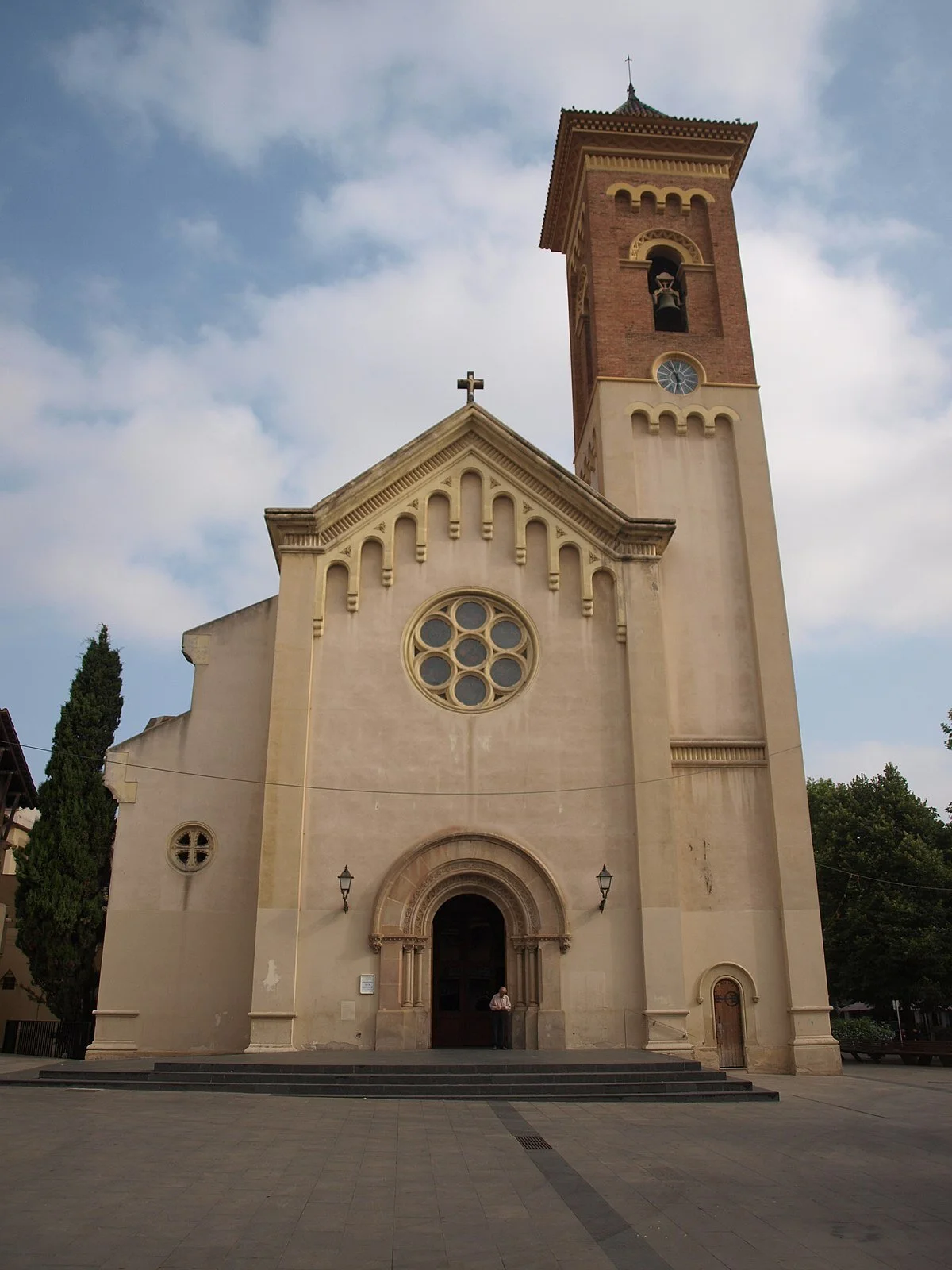
The Sant Martí church in Cerdanyola del Vallès.
Nearly every memory I have of church involves attending Mass with my mother. While my father and siblings slept in on Sunday mornings—he still rose at dawn to work at the mechanic shop downtown; my younger brother and sister still shared a bed—my mother would wake me up bright and early to go to St. Elizabeth’s. I was ten or perhaps eleven, and while most kids that age would have complained about having to wake up at 7:00 to go to church, I actually looked forward to going. Like most other Latino kids my age, religion was important in my household: God wasn’t an abstract concept to us; God was instead a very real presence capable of unimaginable blessings or of completely upending our lives.
But it wasn’t devotion that made me get up on those Sunday mornings. I had a healthy respect for the divine, but being bookish from a young age, I was more attracted to the biblical stories which, in my mind, were reminiscent of the Greek myths. At a young age I equated Samson with Hercules, Eve with Pandora, Jehovah with Jove. I was also immensely interested by the ritual and pageantry of the Mass itself: the slow, somber steps of the altar boys as they entered the church, holding the crucifix high like a battle standard; the green-eyed priest (who would figure into a story I’d write years later) blessing the crowded pews as we all crossed ourselves, drops of holy water getting trapped in our hair; the bouquets of bright flowers that crowded the feet of the blind saints that silently guarded the church. Incense. And the music. My mother and I always went to the Spanish-language Mass that was held before the English mass on Sundays, so the strum of guitars and the happy rhythms of Spanish hymns still echo to this day in my mind.
I was attracted to the ritual of the Catholic faith very much like Oscar Wilde who converted to Catholicism on his deathbed in 1900. Years later, when I read The Picture of Dorian Gray and his exquisitely painful letter De Profundis for the first time, I certainly saw myself reflected in the way he understood religion and his own relationship to faith. He claimed to have fidelity to “what one can touch and look at” which is a sentiment that I can absolutely relate to. Because isn’t it easier to believe in something, or someone, who makes their presence known? Or, as Wilde would write in De Profundis,
When I think of religion at all, I feel as if I would like to found an order for those who cannot believe: the Confraternity of the Faithless, one might call it, where on an altar, on which no taper burned, a priest, in whose heart peace had no dwelling, might celebrate with unblessed bread and a chalice empty of wine. Everything to be true must become a religion. And agnosticism should have its ritual no less than faith.
I’ve always loved the way that Wilde declares something to be an absolute truth. And that last line about the rituals of agnosticism being “no less than faith” became even more pertinent to me as I grew older.
Years after my mother and I stopped going to Sunday Mass (she started working on Sundays, while my interest turned to other areas), I, too, would have my own battles with trying to define my spirituality. This involved a wide range of phases.
For instance, I associated with Jehovah’s Witnesses for the better part of my last year in middle school. I loved reading the Bible and talking about what lessons one could extract from these ancient texts (excellent training for university studies later on), but I couldn’t agree on other aspects of their faith, such as a ban on blood transfusions or even celebrating your birthday. I was thirteen, just entering puberty, and I was quickly becoming aware of my attraction to other men. So when I developed a crush on Nathan—dimples, a junior in high school, a shy beard beginning to sprout unevenly on his cheeks—and I learned that being gay was incompatible with the kingdom of God, well, I didn’t stick around much longer.
I then entered a different phase of my spiritual evolution: basically, I didn’t believe in anything. I didn’t believe in the Christian God or the Allah that belongs to the Muslims. I thought religion was for the weak of spirit and the intellectually dull. I remember long, twisting arguments with my parents who would try—beg, even—to convince me to believe in God again, to bend my knee in submission, to accept religion as part of my life once more.
But I couldn’t. As a teenager, there were so many aspects of our society that just didn’t make sense to me. Why would a deity allow bad things to happen to good people? If God heard our prayers, why didn’t he answer them? Why do bad things happen to those with the cleanest souls, while those with polluted spirits are allowed to roam free without any seeming consequences? Simply believing in God wasn’t enough for me, and I couldn’t believe in something or someone who seemed to have such a disinterested attitude toward their creation.
My doubt in God lasted through high school, and once I began college and discovered a myriad of books that helped me articulate my points, I couldn’t be convinced otherwise. Shortly after I graduated from UCLA, and during a particularly low period in my life, I encountered a different kind of faith that I felt could answer a lot of my questions: Buddhism.
Gone were the deity-centric beliefs tenets that I’d learned growing up. Holy water evaporated from marble bowls, candles snuffed out. Scrolls in Sanskrit replaced crucifixes decorated with purple silk. Chants substituted for hymns, motivational speeches instead of sermons. I felt I’d finally found a match after a long quest.
My Buddhist faith lasted for a few years. It got me through some really tough times and I met a lot of incredible people who shaped my life and my perception of the universe, but after I moved to San Francisco and lost contact with a lot of people, my faith started to wane. This accelerated once I started graduate school, and though I still retain large parts of my Buddhist faith and training, I no longer consider myself a practicing Buddhist.
Indeed, it was in graduate school that I found another type of faith: literature. At the risk of sounding cliché, it took a long time for me to understand that the faith I’d been searching for all along—perhaps the faith of my ancestors, the god of my nameless yesterdays—has always been there, waiting to be discovered in the pages of the Bible or in Shakespeare or Milton. It is no exaggeration to say that I have been equally as awed by passages of One Hundred Years of Solitude as I have by rereading portions of Genesis. I have been moved to tears by the sermons espoused in Baldwin’s Go Tell It On A Mountain much in the same way that I cried as a child when I contemplated the mysteries of the passion of Jesus. Literature has always provided me the solace I’ve searched for in religion. And for me, this has been enough.
But, of course, the evolution is not complete. Today is Day 28 of the government-enforced lockdown in Spain, and though things are certainly getting better (no new cases reported in Cerdanyola, and today we’ve had the lowest rate of deaths and infections in Spain in nearly two weeks), I recall those moments when even books weren’t enough to console me. At the beginning of the pandemic, I couldn’t concentrate enough to read and only found interest in news and finding out as much as I could about the coronavirus and how it was threatening our way of life.
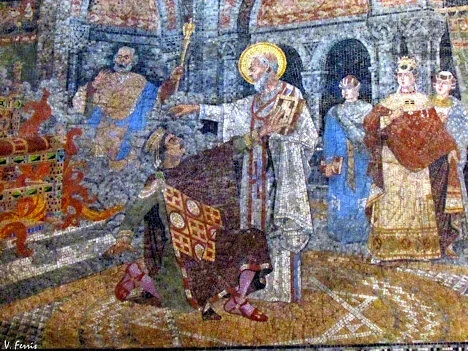
Altarpiece in Cerdanyola del Vallès.
That first night, for example. We’d just finished our grocery shopping and were preparing to be locked indoors for an indefinite period of time. As I’ve detailed in previous entries, death seemed to stalk the streets, and the threat of disease was everywhere. I was worried about my family and friends both here and in the United States and watching the news and the ever-increasing death tolls and infection rates I simply started sobbing in the middle of dinner, just feeling helpless.
It was too late to call my parents or a friend. Franky couldn’t console me either. I just pushed aside the plate of food, guzzled down my wine, and just wept. Franky sat there next to me, helplessly looking around the room as if he could find a secret to making me feel better. After a few minutes, I excused myself and went to our bedroom where I lay down on our bed and stared up at the ceiling.
I don’t know how long I was there. It may have been an hour or perhaps two, but all I know is that by the time I noticed what time it was, Franky had fallen asleep on the couch to give me some space. That’s when I thought of those Masses that I’d attended with my mother nearly thirty years ago, of the solace I used to find when I knelt in the pews alongside my neighbors.
As if by instinct, I knelt at the side of my bed. I looked up at the blind ceiling, unsure of what to say. It had been years since I’d prayed last—I think the last time I’d sent up a silent supplication was last year when my Tía Ana was on her deathbed. Even then it had been a complicated feeling: I was sincere in my feelings and desire for my tía to recover from her illness, but felt conflicted about kneeling like a child.
That night though, at the very beginning of the pandemic, I looked up at the ceiling and simply spoke. I didn’t pray to any one deity specifically, nor did I implore the universe to intervene in its countless mysterious ways. I didn’t feel the spark of the divine, nor did I feel communion with the Almighty. I cannot be disingenuous.
I spoke out loud to bring my wishes into being: for the pandemic to be lifted from us, for the ill to be healed, for the suffering to find comfort, for my loved ones to be protected from the scourge of disease. For the lonely to feel the warmth of company, for our jobs to remain in place, for our livelihoods to be robust, for my nephews to grow up strong and healthy and for them to inherit a better world.
I prayed for nearly an hour, my knees aching by the time I stood back up, I felt better. For a moment, just a moment, I was transported back to those Sunday Masses with my mother, where next to her the world was stable and unchanging, and when naked faith was enough to fill the darkness with light.