Life in the Times of Coronavirus: Lockdown Day 12
Today marks a dozen days of desolate streets. This coming Friday will mark two weeks since things accelerated very quickly all over Spain due to the coronavirus pandemic. We’ve spent 95% of that time indoors, adhering to the strict regulations in place during the government-enforced lockdown. And though the state of emergency is due to expire on April 11, and the confinement is due to end on April 13, the feeling among most folks is that it will most likely be extended until the end of April. Spain, which has as of today surpassed China in terms of the death toll, has an astounding 47,610 cases of coronavirus, of which 9,937 are in Catalonia.
Hotels-cum-hospitals are starting to spring up in Barcelona and Madrid. And, more grimly, the Spanish capital has also started using the Palacio de Hielo ice rink as a makeshift morgue to house the dead before they are buried. Like in Italy, funerals are banned in Spain to avoid groups of people, meaning that the deceased are interred or cremated without family present. This is perhaps the cruelest aspect of the coronavirus: when one dies of the illness, one is forced to die alone.
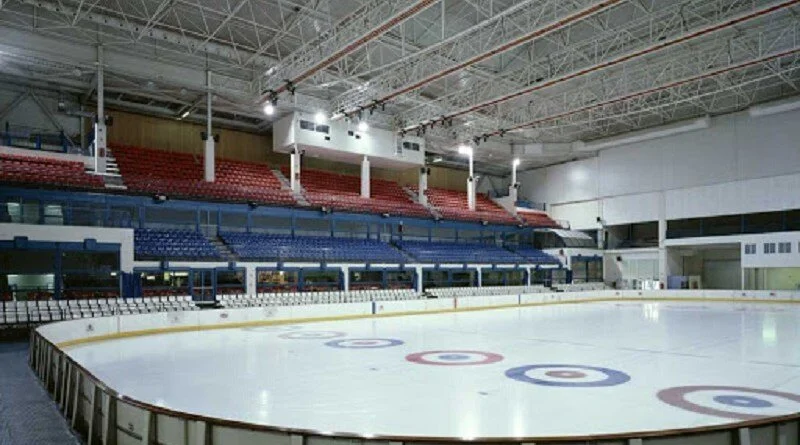
Palacio de Hielo in Madrid.
These are indeed dark times for many of us. We personally haven’t been personally touched by the coronavirus (i.e., I don’t know anyone personally who has become ill), but as is the case in a lot of cities and countries around the world, we are all navigating through these very difficult times. There’s hope that Spain is reaching the peak of new infections, but as with everything, this is still largely hypothetical.
Since I’m a freelancer, I was accustomed to spending time indoors. More than one springtime afternoon has waned while I sat at my desk, and I’m used to working a lot, and at places that are all closed: cafés, libraries, the local university. Of course, I always had the option of going outside, and didn’t have to “suit up” to run even the simplest of errands, so not being able to go outside much didn’t weigh on me. Now, that return to normalcy seems to be the only thing on my mind.
For the meantime, though, we are being tough and finding the best ways to make the most of our current situation which, compared to others, is privileged. And one of the most curious (and perhaps unexpected) aspects of our obligatory confinement is that, with limited stimuli, you become more sensitive, more aware, of the people that surround you.
My neighbors, for instance. We live in a nine-story building that was constructed in early 1970s, during the final throes of the Franco dictatorship. We live on the second floor. The building is not what I would call beautiful: the red paint seems to be rusted, the handrails are ancient and sharp edged, and when someone deep fries their dinner, we all have to shut our windows lest the smell invade all of our homes. My interactions with our neighbors are limited to polite greetings on the landing, a nod of acknowledgement in the stairwell, small talk in the timeworn elevator.
Now, in the midst of the coronavirus pandemic, when we’re all stuck indoors, I hear them all the time. Not the perfect time for thin walls, admittedly.
A Peruvian family lives right above us; the son works at one of the to-go restaurants in our town, and the mother works at one of the cell phone store branches located in our town. Both businesses are temporarily closed, so they’re both stuck at home with the rest of us. I’ve come to recognize the rhythm of their days: around 9 in the morning, the son gets up and takes a long piss. For a full ninety seconds, it sounds like he’s pouring water into the toilet while standing on a chair. Around eleven, the mother does her aerobic exercises. On any given day, Daddy Yankee, J. Balvin, and Bad Bunny belt out songs while she does her jumping jacks (50 – yes, I’ve counted), burpees and squats. The living room lights shake slightly as she exercises. When I hear the shower roar to life, I know she has finished.
Next to us there lives a Spanish family of four: mom, dad, and two little girls. I know that the both the father and mother have been temporarily laid off due to the coronavirus pandemic, meaning that they also spend all their days indoors. They are stressed about money given their minimal savings, and they are also worried about the wife’s mother. You might be asking yourself how I know all this. Well, I heard them arguing over the grocery bill not too long ago (a fork slammed down in rage, a palm slapped against the bare wall) through our thin walls while I sat reading in the living room.
On the opposite side, there is a family of six crowded into a (relatively) small flat. There are three elderly people, a middle aged man (who I think is mentally disabled), and two kids (a boy and a girl). Despite the fact that my home office is located right next to their living room (i.e., we share a wall) I have not been able to ascertain the relationship between them. The only thing I can say for sure is that the middle aged man has an irksome smoking habit. I say irksome because he smokes cigars, and as you probably know, they release a curling, heavy smoke that permeates any space it seeps into. We’ve lived here for nearly six years, and more than once I’ve made the mistake of leaving a window open, only to have our entire flat smell of cigar smoke. (GROSS.) These days, it’s been a challenge having to politely ask the man to “please step a bit closer to the balcony and blow the window toward the street.” But he does not listen, or is incapable of understanding me because of his condition. So we keep everything closed until we are sure he is not smoking.
These, of course, are all small inconveniences compared to what’s going on in Catalonia and Spain. It is curious, though, what a crisis makes you do: notice the smallest details, and constantly be aware of the people around you.
And, of course, there is the part that I’ve mentioned over the last few days, that beautiful word that I am becoming ever more aware of: community. As many of you know, every evening people all over Spain come out onto their balconies at exactly 8:00 p.m. to applaud the efforts of the medical professionals, as well as police officers, cashiers, janitors, and anyone else who is forced to go to work despite all the dangers. It is called the aplauso sanitario here – literally something like the “healthcare applause.”
No matter what I’m doing at that specific time – writing this blog, editing a story, finishing work – I always make the time to clap along with our neighbors. From our balcony, every night I see dozens of people standing out on their balconies. Some flash their cell phone lights, others jump up and down, shouting “bravo!”. Still others blast music (a favorite these days is “Sobreviviré” by Monica Naranjo). The title means “I will survive” – you can see the appeal during these terrible days. Check it out.
I also make sure I never miss out on the applause to remind myself of the importance of community, whether from a balcony or virtually, in these critical times. Because, despite the empty streets and shuttered businesses, despite the relentless stalk of the virus and the mounting death toll, despite the phantom of uncertainty – for a moment every evening, we all come together as one as if, in unison, to shout that we are out of sight but still here, still withstanding impossible odds, still standing strong.