Life in the Times of Coronavirus: Lockdown Day 11
Today is Day 11 of the government-enforced lockdown in Spain. After dinner last night, we were both in the mood for something sweet, so we opened the fridge to see what desserts we had left. We’d been rationing pretty much everything we bought when we stocked up – orange juice, napkins, meats, cereal, coffee, detergent, bread, beans – to put off going to the grocery store for as long as possible. But now we were running out of basics like rice, chicken broth, toothpaste, disinfectants, cat litter. And desserts. We opened the fridge and found a single yogurt, which we shared along with a few strawberries that I’d forgotten I’d stowed away.
The urge to ration, the scarcity of some basic supplies, being obligated to comply with the state-mandated lockdown orders: I have been forced to adjust to the very abrupt changes that have happened over the last few weeks, and while it has not been easy, I’ve been doing my best to stay positive, to keep my wits about me, to not fall down a vortex of panic. I suspect some of you reading this are experiencing the same thing, or will be soon, anyway.
Evidently, these travails take a toll. And I am learning that though the mind may not be conscious of the stress one is under in these trying times, the body processes it all the same. Tense shoulders, headaches, spasms. Because grief, much like a virus, mutates. It infects. It invades. But it, too, is overcome, and once it has passed it leaves in its wake what almost feels like a cliché, but which is an inevitable result of all of this: a newfound gratitude for the smallest, most ordinary acts (like greeting each other with two kisses here in Spain, something that has disappeared during the pandemic); and a renewed awareness of the many ways I am indeed blessed, and of the urgent need to help other that are less fortunate. Now, I grieve for the old world, despite all its imperfections; and I pray to remember the lessons I’m learning now when our global community enters our new, communal existence, something which is being written as I type.
With truly breathtaking statistics being published today (nearly 40,000 confirmed cases and 2,800 deaths in Spain; Catalonia has almost 8,000 cases of COVID-19), I was anxious about having to go to the grocery store. Right now a trip to the market requires careful planning and provisions of its own (gloves, mask, disinfectant) to avoid becoming infected. It is in fact a calculated risk. But after reviewing our shopping list, I printed out my authorization slip, put on my gray sweats and latex gloves, fastened on my mask, and decided to head out.
I hadn’t been outside in a week, and the world was pretty much as I’d left it. The rusted fountain still spouted water clumsily. Green parakeets, so common throughout Cerdanyola that they have practically become our town’s mascot, were still perched on their shaky branches, chirping away the time. The carpenter’s shop that had closed permanently a month ago remained shut down. The only difference, of course, is that on the walk from my house to the garage where my car was parked, I didn’t see a single person. Not one. I saw an elderly man and a woman pushing a stroller as I drove to the grocery store. I saw a guy about my age sitting on a bench, tying his shoe leisurely, and further on a young woman sat on the curb, smoking. She held a gloved white hand to her naked lips and let the smoke curl silently into the open sky. In my rearview mirror, I watched her flick the cigarette butt onto the asphalt. Its tip burned angrily.
I didn’t get stopped by the police, much to my surprise. I pulled into the Mercadona parking lot and immediately saw that the line to get into the store extended well into the parking lot. I parked and quickly grabbed a cart before securing my place at the end of the line. Mercadona, like all grocery stores in Spain, must guarantee that its customers can maintain the recommended meter and a half security distance. It can also only have a certain number of people inside at any given time, hence the line you see here.
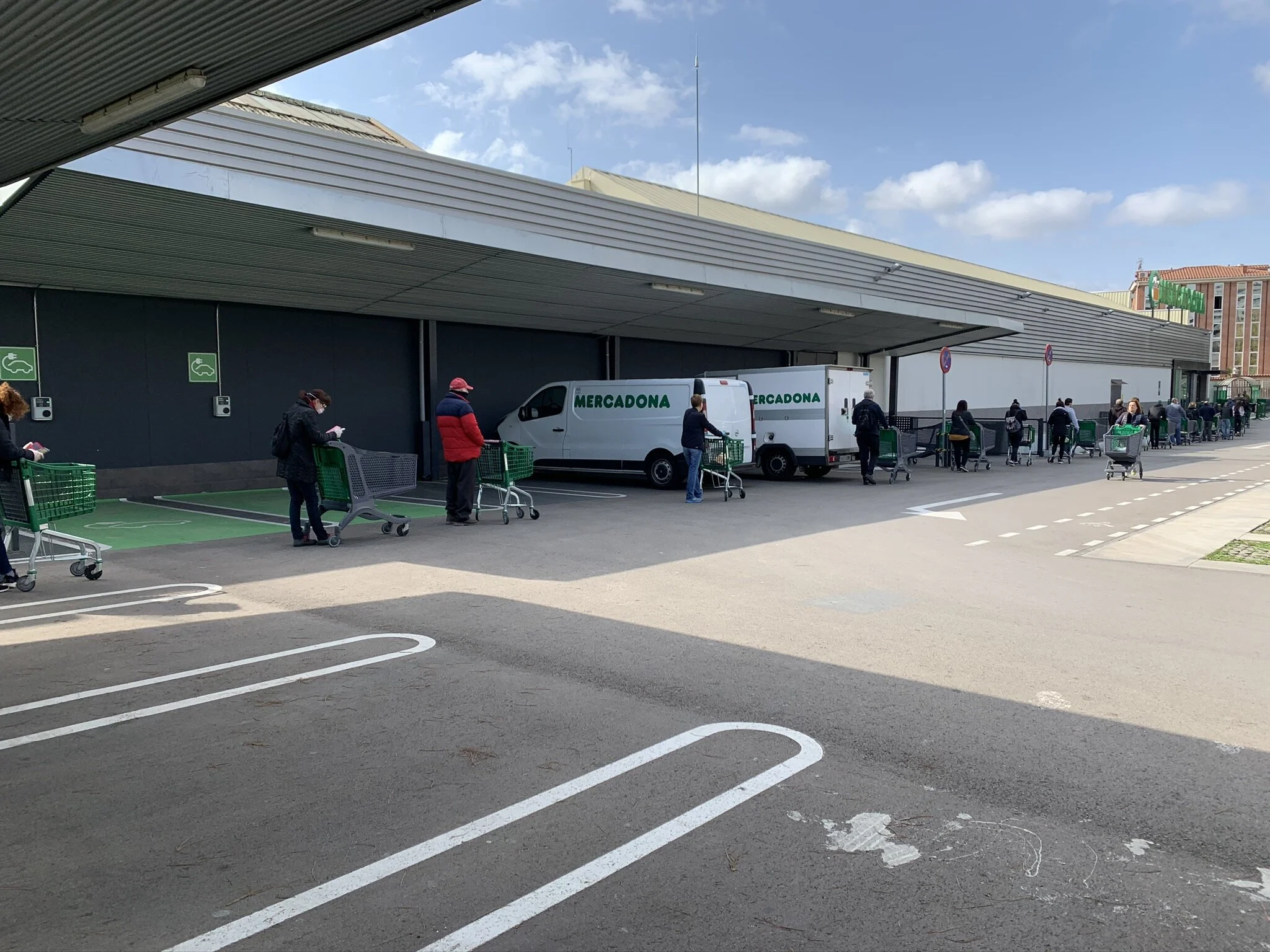
I stood in line for about thirty minutes before I made it to the entrance. A security guard wearing a mask tried to hand me a pair of plastic gloves, the kind that you use when you’re buying fruit.
No, thank you, I said, and held up my hands. I came prepared.
Sorry, sir, the security guard said curtly. Gloves are mandatory. He held them out to me again.
Gloves on top gloves, I said, slipping them on. Talk about protection. I smiled behind the paper mask I was wearing.
The security guard said nothing and waved me inside.
Things were relatively calm, thank goodness. No panicked shoppers running to the toilet paper aisle. No arguments over the last sack of potatoes, or that final, forlorn bag of croissants. No barren shelves, no bruised onions rolling around the floor, no shattered eggs, no slow-moving, overflowing carts. Just people in face masks and gloves standing as far as they could from one another.
As I walked the aisles crossing items off my list, I couldn’t help but notice the upbeat pop music that was practically blasting in the grocery store. Do they always play this music? I wondered. Or is it special, something which they were playing to keep everyone’s spirits up? Either way, the scene was surreal: I felt as if I were trapped in some post-apocalyptic universe set to the soundtrack of my previous existence. The music, and the squeak of our carts, were the only sound: no one spoke to each other, even people who knew each other. They simply extended a gloved hand in the air (one man saluted military style) or nodded behind their face masks, making extra effort to make their eyes bright. Because, of course, masks may keep germs out, but they also trap smiles inside.
An elderly señora about my grandmother’s age was standing on her tiptoes, trying to reach one of the last box of crackers. She was not wearing a face mask, but had gloves loosely fitted around her hands. She had a walker. Instinctively, I moved to help her, but stopped in mid-step. Since she’s part of the group that’s highest at risk, I needed to take special care and not get too close.
The lady saw me and motioned for me to come closer.
I’ll gladly reach it for you, I said, not moving. Just move a little bit so I don’t come near you.
You gonna bite me or something? she said, nearly chuckling.
Well, I won’t harm you, but that damned virus might, I answered.
Don’t you worry about folks like me, she said, moving a few feet in the direction opposite me. I’ve seen it all. Nothing gets to me.
I walked closer, picked up the crackers, and left it on a shelf that was lower so she could reach it.
Thank you, majo, she said, picking up the small white bag.
I smiled behind my face mask and told her that she was very welcome.
And then, as if she were reading the heavy thoughts on my heart that morning, she spoke to me again.
Remember that nothing lasts forever, she said. Especially crackers.
That’s life for you in the time of the coronavirus: philosophers abound, even at the supermarket.