Life in the Times of Coronavirus: Lockdown Day 7
Today started out rough. Perhaps it was the sunshine streaming in through my living room windows on today, the first full day of spring. Or the news that California had also ordered its citizens to stay at home, sparking another silent shower of worries inside of me. Perhaps it was seeing the café I usually work at, the one with the matronly Andalusian lady who calls me jomío (hijo mío) with its metal curtain pulled down tight? (A week before all this went down, she was complaining about business being slow, and how she might need to close down despite still owing the bank money. I hate to think of how she must be feeling now.) Was it the news coming from Bergamo in Northern Italy, where the cemeteries have run out of room for the dead, and where even funerals are forbidden? (And even when exceptions are made, the attendees are not allowed to embrace one another.) Moreover, footage was released of 15 military trucks transporting coffins with coronavirus victims directly to the crematorium. These, I am certain, are all things that will always be with me, and that I shall always remember the dark winter of 2020.
More locally, Spain has surpassed 20,000 confirmed cases of coronavirus, and more than 1,000 deaths. Catalonia has about 3,500 confirmed cases. Experts have said that the first peak of infections has already been reached in Spain, but another three waves are to follow. It’s good news, but we’re not out of the woods yet. Because I think that this information, however grave, will be relevant to most of you reading this blog as the virus will most likely follow a similar pattern wherever you might live. From today’s edition of La Vanguardia:
Spain has reached the first peak of the coronavirus epidemic. The number of daily infections, which reached a maximum number on Friday, March 13 and Saturday, March 14, has started to decline following the lockdown orders in place since Sunday. But controlling an epidemic can’t be likened to climbing a mountain. Instead, it’s more like a long uphill portion of the Tour de France: you’re done with the first hill, but other, harder hills are yet to come.
In Madrid, crematoriums are operating 24 hours a day, 7 days a week to dispose of the dead. (The regional president predicted that 80% of people living in the Spanish capital are expected to contract COVID-19, a mindboggling number if it comes to pass.) So yes, better, but unfortunately it seems that the worst is yet to come.
Amid so much bad news, it was hard not to slip into a funk this morning. But as I’ve been writing, I don’t let myself stay down for long. Instead, I had breakfast while sitting in the sun and drank in the cool morning air. I played with Chaplin, our six-year-old cat. I then worked for a few hours until I had finished everything that was on my schedule, and even managed to edit a poem I’ve been polishing for a few weeks.
We turned the news back on at lunchtime in case there were any new restrictions being placed on Catalonia. Thankfully, there were no new prohibitions, but there was a new exception where children on the autism spectrum are allowed to go outside with adult supervision and while observing the 1.5 meter security distance. The Spanish army has also arrived in Catalonia to disinfect the airport, port and other public areas. Seeing camouflaged soldiers brandishing their weapons while others dressed in hazmat suits spray down the very same terminal that I visit regularly was, well, unbelievable.
Later, this hit closer to home. Literally. I was out in the balcony talking to my brother when I heard the distant approach of what sounded like a garbage truck. As it came around the corner, a woman who was part of the municipal cleaning services was disinfecting the street below our flat, as you can see here:
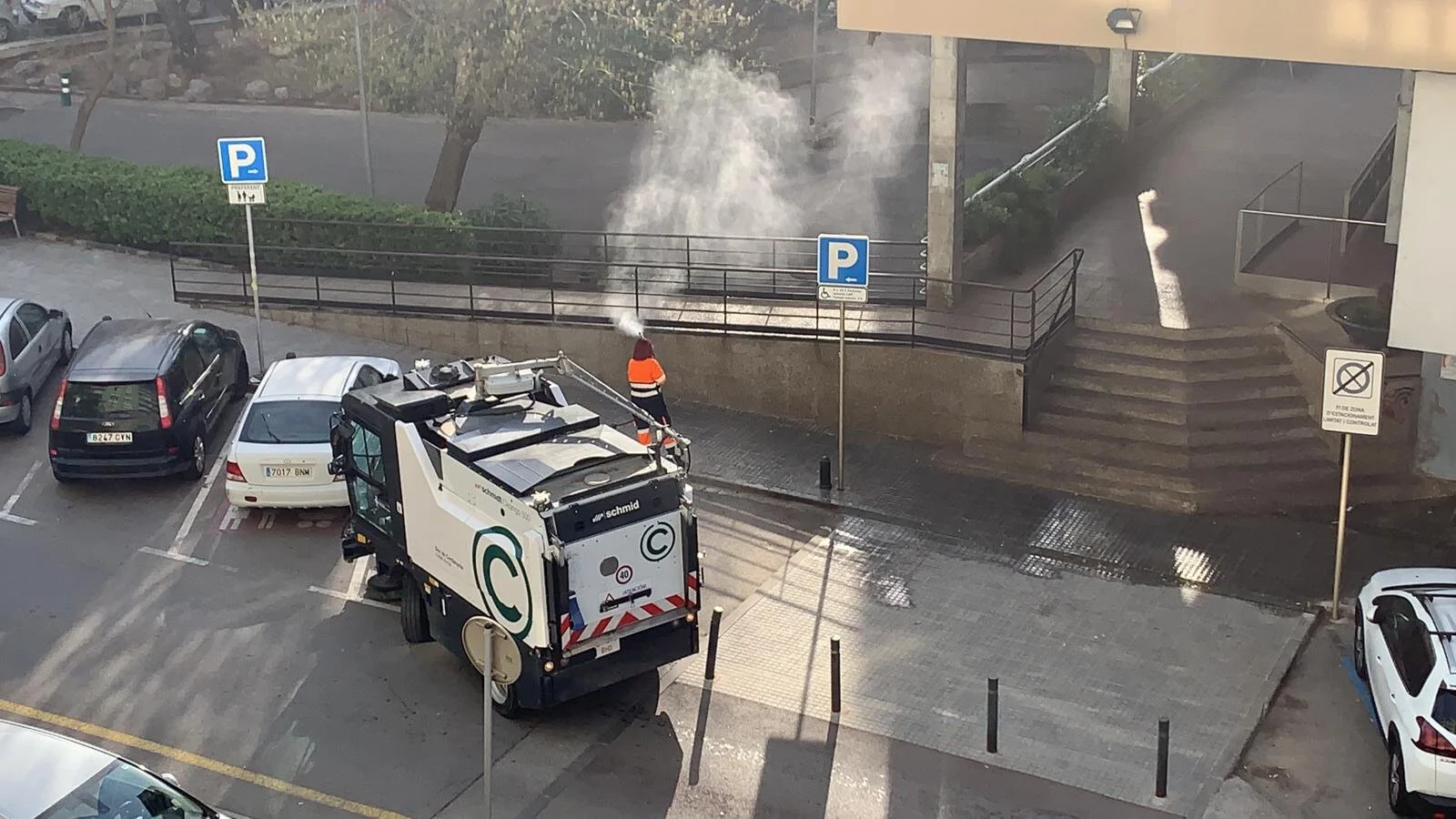
As she sprayed down the asphalt, the spaces between the cars, the ash-colored steps and the rusted handrails, the sunlight filtered through the water. I smiled at what I saw: such a little thing to notice, but these days it’s the little things, the small moments of beauty, that keep you going from one day to another. And today, I was grateful for what I saw, because though the woman was executing the grim task of disinfecting our neighborhood during the coronavirus epidemic, there was still beauty to be found in it, and by extension, hope. Today, it was enough to lift my spirits, enough to let in a little more light.
If I had any advice to impart on you, dear reader, it would be this: remind yourself that this quarantine, whether self-imposed or government-mandated, is temporary and for the greater good. The sacrifices we make now will pay off in a few weeks when we, as a society, have gotten a greater handle on the current crisis. And in the meantime, slow down, appreciate the spring that no virus can stop, and be grateful for what you have. If the worst is yet to come, may we all be wise enough to at least recall the small miracles that can propel us through this dark night of our collective soul.