Life in the Times of Coronavirus: Lockdown Day 8
I woke up this morning feeling a bit homesick. Not the crushing, consuming kind that overtook me at times during my first few months in Barcelona, especially on Thanksgiving, New Year’s Eve, and when I turned 30 in April 2012. Just the kind provoked by concern for friends and family both in Europe and the United States.
Today, the first thought that came to mind was my parents in Southern California who, much like a lot of other people (including some of you) will head out to hunt for the basics (meat, rice, cereal, fruits and vegetables) early in the morning before the crowds ravage everything in sight. My sister, who has to plan on what to do in case she cannot find diapers, is hunkered down at home with my three nephews (one of whom is on the autism spectrum) while my brother-in-law evaluates his business to see how they’ll manage financially during the crisis. And my brother and his wife are also under lockdown due to the coronavirus pandemic and are finding it difficult to come across the basics. Much like here, having groceries delivered isn’t really an option either, given the extremely high demand and the fact that most places have discontinued home deliveries. So most folks will have to head out to look for whatever scant food remains.
Indeed, for most of us, scarcity has become a new reality, a fierce reminder of the privileges that we had before the coronavirus pandemic broke out. I, for one, know that I will have a greater empathy for those that have been dealing with situations much harder than what I’m going through. This will always live with me. For some, empty shelves and constant worry over food and supplies are unfortunately facts of life, not to mention the myriads that cannot afford them to begin with. I am not trying to be dramatic in narrating our situation here in Catalonia – I know that despite the shortages and long lines, the situation is only temporary as there is plenty of food to go around. I just mean that no one here in several generations have ever had trouble finding red meat or zucchini or (of course) toilet paper and this dramatic change forces you to accept the reality of the situation.
I haven’t been to a grocery store since last Saturday and have only ventured out to throw out the garbage or to get stuff out of my car. Going anywhere outside feels like embarking on a true odyssey in these strange times: latex gloves pulled taut around cuffs, face mask fastened, glasses high up on the bridge of your nose. A beanie for added (psychological) protection, and gray sweats that are to be used only when we have to go somewhere where there are people. And all of this is peeled off in the foyer, along with our shoes, before we head straight to the shower to wash off the contagion of fear. (Fear feels inevitable, considering that there are nearly 26,000 people infected with coronavirus in Spain, and with 4,700 in Catalonia.) A bit extreme, perhaps, but at least it gives me peace of mind.
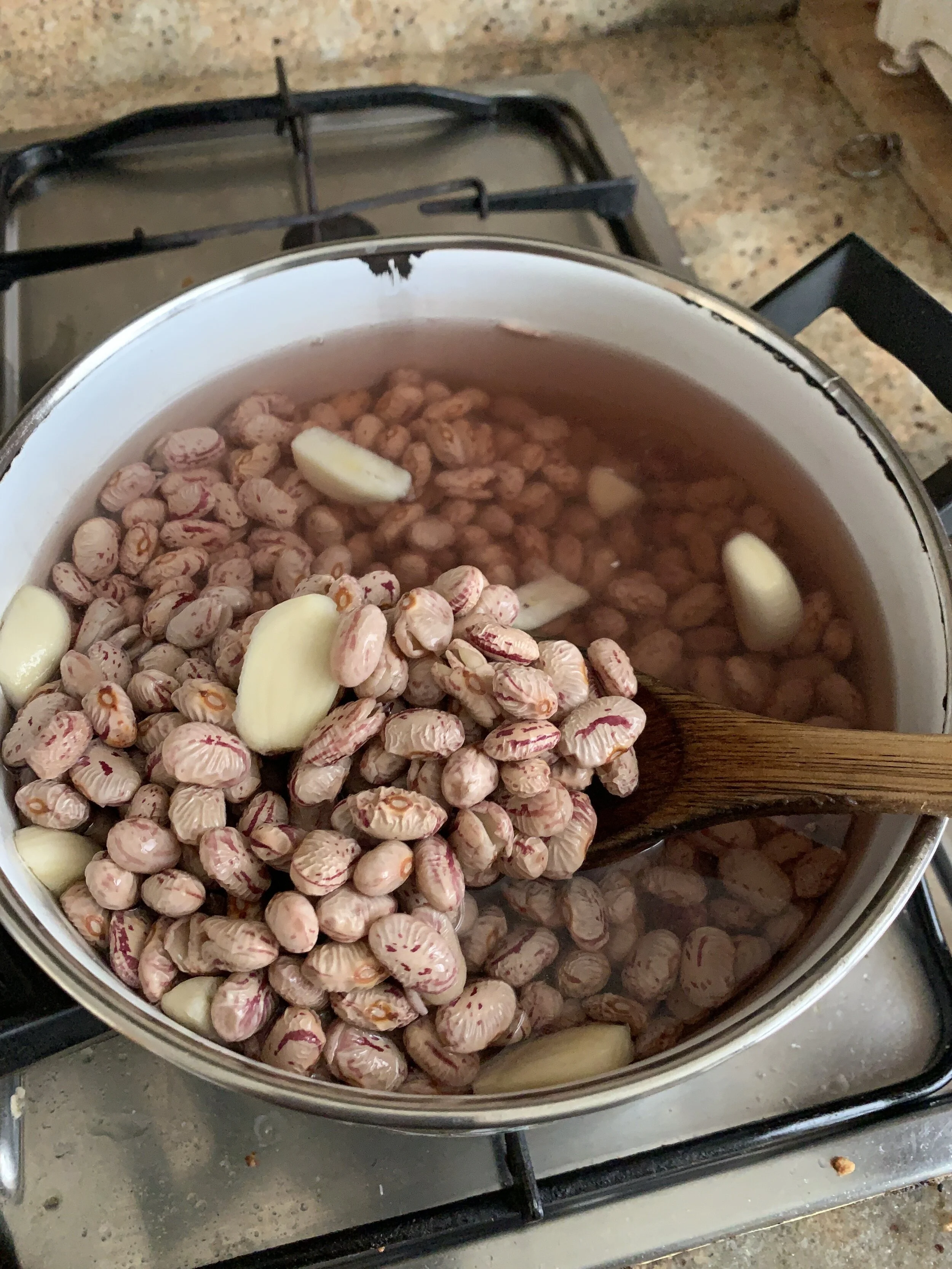
Anyway, the last time we went to the grocery store I managed to pick up the last kilo of pinto beans, the same kind my mother frequently makes at home. And because I was feeling homesick, I decided to cook some this morning. (For those of you that may never have cooked this delicious and nutritious dish at home, frijoles pintos are simple to make. All you need are the beans, garlic, salt and water. I let the frijoles soak for a couple of hours with the salt and garlic before slowly boiling them for 3 or 4 hours. You have to stir them every 10 minutes or so, and add water as you it evaporates. Taste them after a couple of hours and once they’re soft, you know they’re done. Don’t overcook them though, or they’ll start to break up and create a type of mash - believe me, I learned this the hard way). If you’re interested in cooking some yourself, check out this recipe.
This morning, I thought about my mother. How she’d pour out a few dozen frijoles onto the kitchen table and, with her glasses perched on the edge of her nose, carefully inspect the beans for any rocks or specks of dirt that may have snuck in. Before the pandemic, I would also pick out any imperfect ones that I’d see. Not today, though: I tossed in the ones that looked unappealing too, because I knew that I was lucky to have beans in the first place. I peeled and cut the garlic and added the salt (not too much, but not too little). The stove’s blue flame flickered on. At first, the beans sat at the bottom of the pot, the garlic floating like crescent-shaped lifesavers. After a few minutes, a brownish color begins to tint the heating water, and the beans themselves become swollen as the heat penetrates them. A few float up to the surface, and when I stir them for the first time they are still hard and bump against the wooden spoon. Twenty minutes later, the aroma of boiling beans begins to fill the house. The smell is difficult to describe if you have never cooked them. It is a distinctive, heavy aroma that reminds me of wet earth, and as the garlic boils, infusing the water with its healing properties, the aroma begins to transform into the more recognizable scent of frijoles pintos.
The bubbling boil of beans, the dance of the garlic cloves as they sink and swirl in the thickening broth, the condensation collecting on the sunlit glass – today I needed to transport myself back to my native Los Angeles and to my family home. I needed to sit in my parent’s kitchen and chat while my mother stirred and my father chopped. I needed to wrap myself in the warmth of my memories when I recall my nephew’s soft hand rubbing my rough beard, or the laughs I shared with my brother and sister. Being far from my family is hard in these trying times, but cooking beans today was enough, just enough, to stave off my worries, to feed my hungry soul.