Life in the Times of Coronavirus: Lockdown Day 19
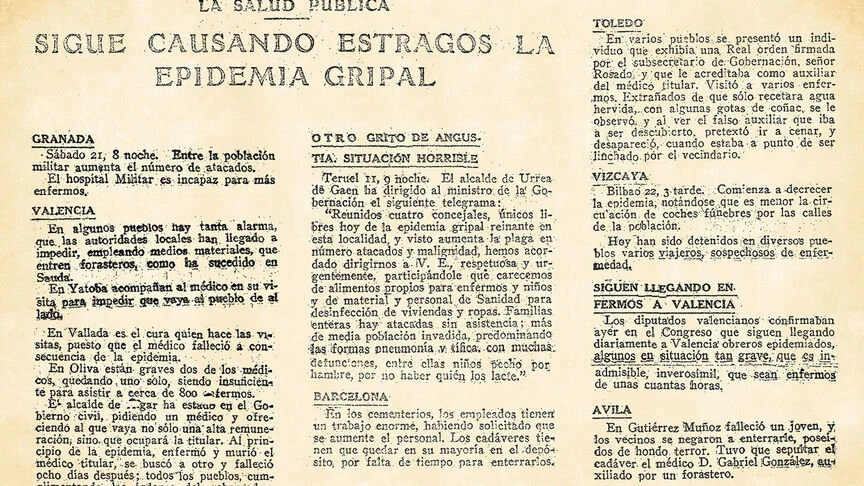
A newspaper clipping from the newspaper ABC. The headline reads “PUBLIC HEALTH: THE FLU EPIDEMIC KEEPS WREAKING HAVOC.” Under the Barcelona section: “Cemetery workers face a herculean task and have requested more employees. Most bodies have to stay in the morgue because there is no time to bury them.” (Source: El Español)
Ever since the coronavirus pandemic broke out in Catalonia, I’ve become fascinated with what influenza pandemic was like in 1918. As is often the case with historical events, things tend to move in a circular fashion: what happened once tends to happen again in a different form.
To that end, I translated an article that I ran across that summarizes the efforts to contain the 1918 flu pandemic, and which also includes interesting remedies recommended by the authorities of the time. (I’ve lightly edited it for clarity.) For this post, I focused on the town of Sabadell, which is located about 30 kilometers from Barcelona (and about 15 minutes from Cerdanyola). History, like always, has a lot to teach us, and more importantly, can also offer us comfort in uncertain times.
The Spanish Flu (1918)
The Spanish flu was a highly aggressive pandemic that is estimated to have caused the deaths of between fifty and a hundred million people around the world in 1918-1919. This strain of flu is estimated to have infected one third of the world's population and had a mortality rate of more than 2.5%, which is very high when compared with the 0.1% mortality rate of other influenza epidemics.
Spain was one of the non-belligerent European countries most affected by the flu. It is estimated that around eight million people were infected and about 200,000 to 250,000 people died, approximately 1.5% and 2% of the total population at the time. (Official figures reduced the number of victims to "only" 147,114 people.)
The most common symptoms of the Spanish flu were a rapid increase in fever, tremors, headache, muscular pains in the back and legs and a dry cough. In the majority of cases described, patients recovered after a few days of bed rest. Other infected individuals, however, died in 24 hours. There is even data from people who were already dead and others who died two or three days earlier.
Origin and extension of the pandemic
The name “Spanish influenza” or “the Spanish lady” (la dama española) originated from the belligerent governments that subjected their press to severe censorship. Thus, when the pandemic began to spread and cause the deaths of many workers and soldiers, they restricted the information so that it would not reach the enemy. The Spanish press, which was not subject to war censorship, was able to report without restrictions on the issue.
Some authors point out that at the end of the spring of 1918, the Fabra news agency sent a telegram to Reuters reporting on "a strange illness with the characteristics of an epidemic appearing in Madrid. The epidemic is benign. No deaths have been reported." From that moment forward, the illness was dubbed the Spanish influenza. The name remains more than a century later, though virologists, epidemiologists and historians confirm that it did not originate in Spain. The first reference to its epidemic character in Spanish medical papers appeared on June 1, 1918 in an article entitled “The Reigning Epidemic” (La epidemia reinante).
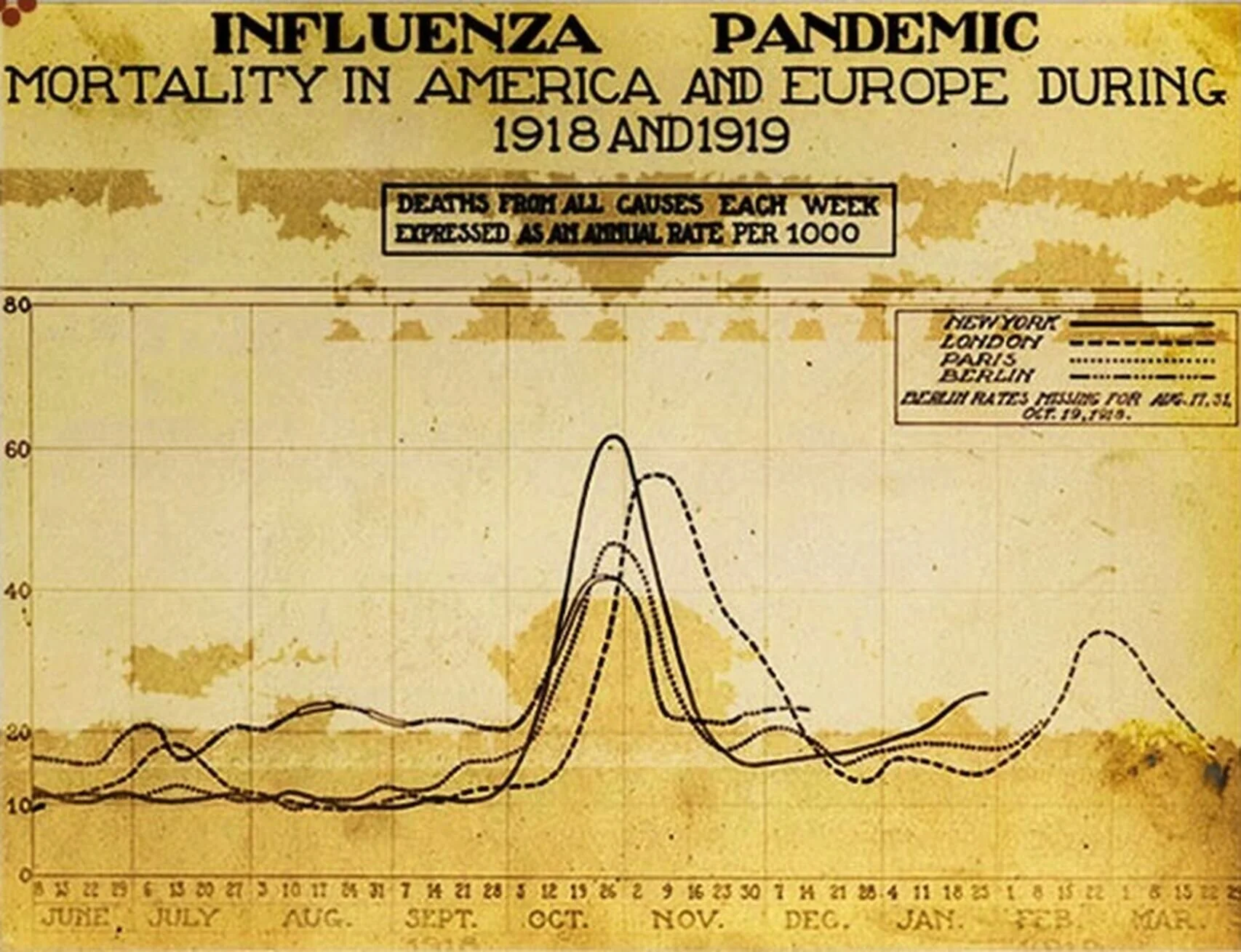
The exact origin of the pandemic remains unknown. Some researchers point to China where many workers emigrated to Europe at that time; others blame the United States, given that the first known mortal case was an American soldier. In any case, the virus spread first to American soldiers and then to Europe at the end of the First World War. Between April and May 1918 it arrived in France, Spain, Italy and Germany, followed by Britain in June and shortly thereafter in Russia. In May 1918, it spread to North Africa, from which it expanded to India, China, New Zealand and the Philippines. The pandemic was spread out over three waves: March to July 1918; September to December 1918; February to April 1919. The second wave would prove to be the most virulent.
It is estimated that in Barcelona, there were some 150,000 infected people. Municipal documentation preserved is scarce and fragmented, so it is difficult to assess the impact of public health measures adopted in the city at the time. This even though La Vanguardia [a major Spanish newspaper] carried out a detailed tracking of the epidemic. However, the effects of the pandemic can be studied via the natural population growth (the difference between births and deaths) as in 1918 this was negative both in Barcelona and the rest of Spain. In Madrid, which was not one of the hardest-hit Spanish cities, the victims of the disease numbered 6,500, 2,500 of them between December 1919 and January 1920, more than a year after the first flu outbreak.
Among the people who were infected and survived is the King of Spain, Alfonso XIII; the prime minister, Manuel García Prieto; Kaiser Wilhelm II; the president of the United States, Woodrow Wilson, as well as the future president, Franklin Delano Roosevelt; the British Prime Minister Lloyd George; and the Norwegian artist Edvard Munch, who painted his self-portrait while ill. Among the victims who succumbed to the Spanish flu are the French poet Guillaume Apollinaire; the Austrian painter Gustav Klimt; the German sociologist Max Weber; Edmont Rostand, the French playwright author of Cyrano de Bergerac; and Yakov Sverdlov, the Bolshevik leader and founder of the Cheka.
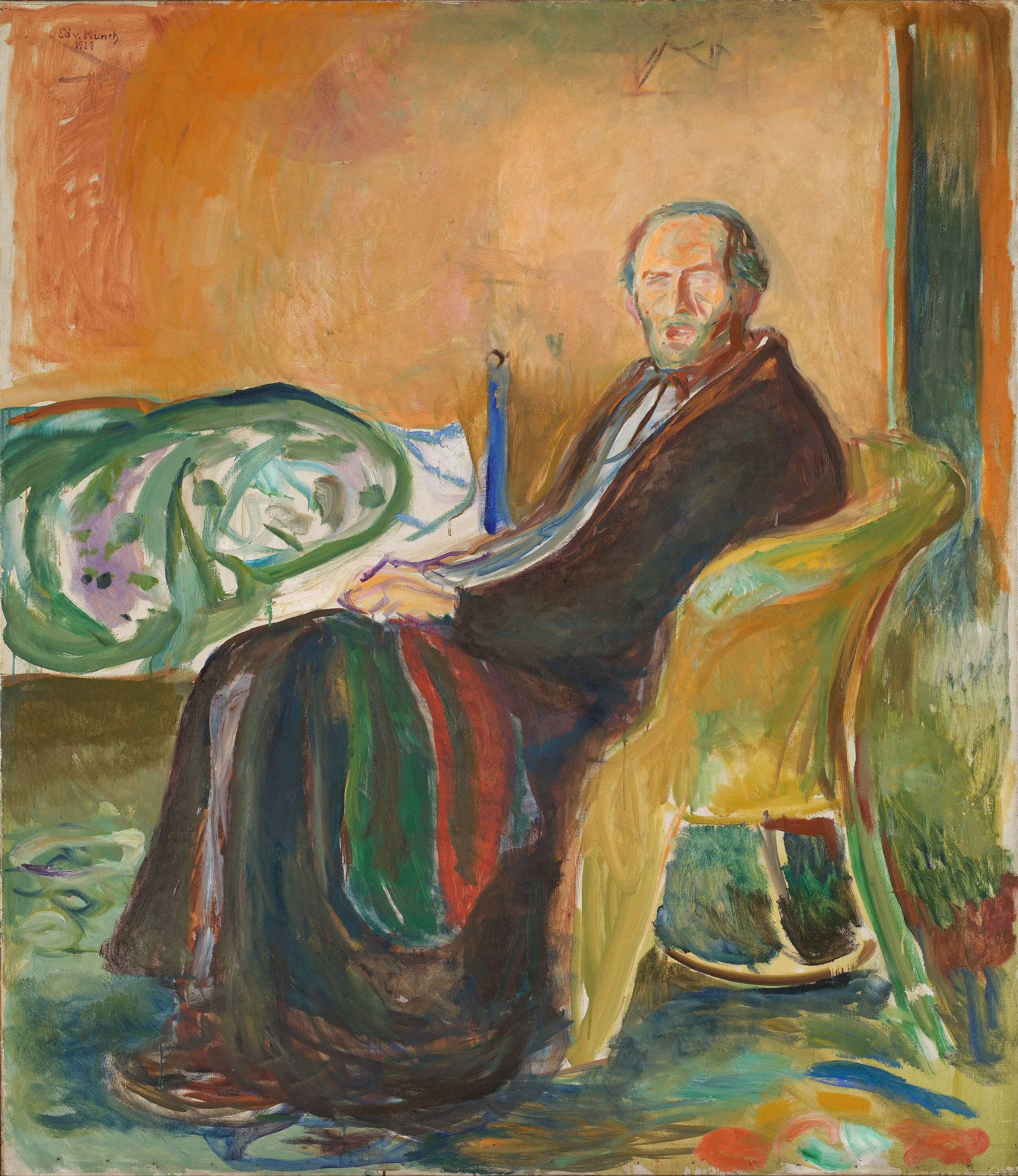
Self-Portrait with the Spanish Flu. Edvard Munch. 1919.
The Spanish influenza in Sabadell
Recently the Arxiu Històric de Sabadell [Sabadell Historical Archive; AHS in Catalan] has published part of the municipal file on the preventive measures that the Council of Sabadell took to fight the epidemic. The documents include the official statistics on the infected from October 25 to November 10, 1918, broken down by day and by the twenty doctors who treated the infirm. The first day, 1,189 cases were detected, and the last day there was just one case, for a total of 1,285 cases.
However, according to the Revista de Sabadell (November 26, 1918 edition), the epidemic peaked on October 13 and continued until the first two weeks of November. In total, it is estimated that the number of people infected was 6,543 with 146 deaths. If we trust this data and bearing in mind that Sabadell had some 37,000 inhabitants, the number of people infected was 17.4 per cent of the population and the death rate was 0.4%.
Also, among the documents published by the AHS, there is a series of fourteen "Preventive Measures" from the Junta for Municipal Health, dated October 8, 1918 and signed by mayor and lawyer Pere Pascual Salichs. These measures were designed to "prevent the grippe that, though it is still benign, has been detected in our city."
Among the measures it is recommends is "the isolation of those who are sick" and "to avoid touching with your hands any suspicious people or those recovering from the illness." Another measure is disinfection of "places where the virus was detected and where large groups of people gather" such as theaters, cinemas or schools. Finally, "moderate outdoor exercise" was recommended, as well as "frequently cleaning your nose and mouth with an antiseptic substance" such as "water with thyme and eucalyptus."
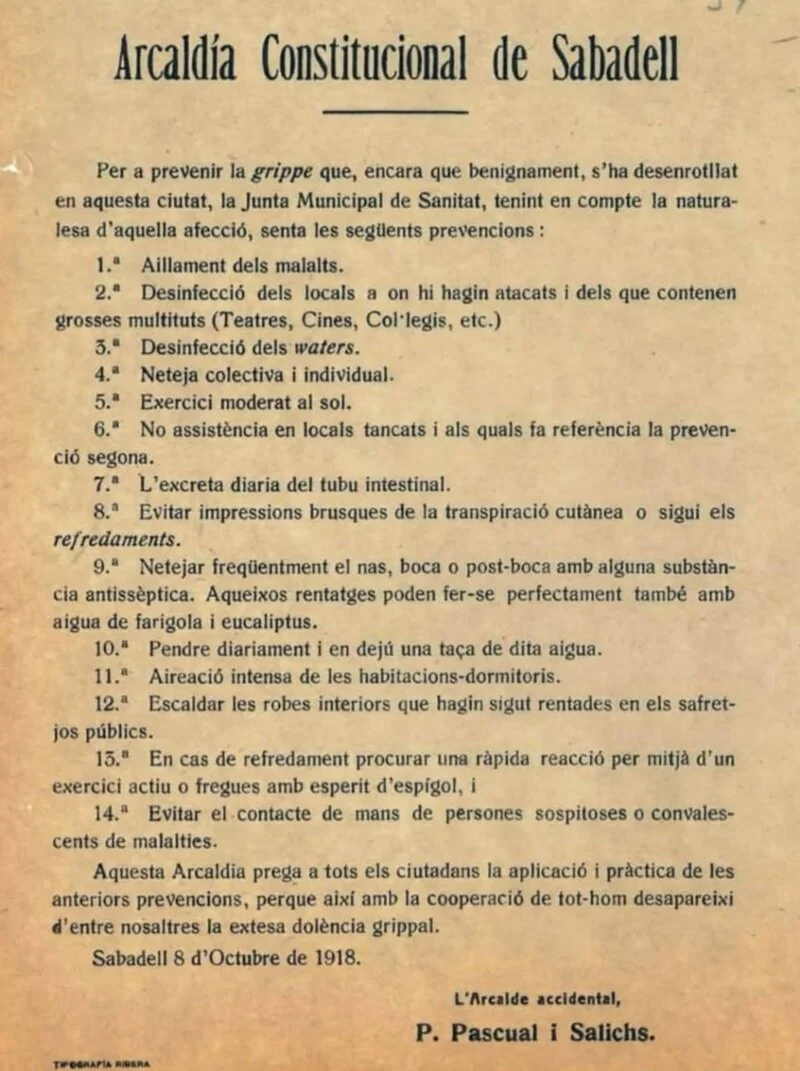
City measures enacted in Sabadell in October 1918.
It must be borne in mind that these were not obligatory measures, but recommendations, as you can read on the side: "This Government asks all of its citizens to apply and practice the aforementioned prevention measures, so that by sticking together, we can make this widespread influenza illness disappear from our communities.”
In addition, in the aforementioned documents there is another order from mayor Pascual Salichs, dated October 14, 1918, to proceed with the disinfection of the municipal dependencies by means of the pulverization with a solution of "2% formalin [antecessor to formaldehyde], which is approximately equal to one tablespoon per liter of water" along with a solution of "lavender, thyme and rosemary."
Also, two advertising brochures from companies that made disinfectant machines were included. The first is the "Metzger disinfection machine” [1913] sold by the Edmundo y José Metzger company with headquarters in Barcelona and Madrid. The second, the “whitening and disinfection machine" called Fix was sold by the company Malths. It was touted as an ingenious creation which "despite having been introduced a few years ago, there are more than 1,000 factories, industrial establishments, charities, state agencies, agricultural colonies and private houses, where the FIX machine is used to the full satisfaction of its owners, as shown by the many letters we frequently receive."
The Catalan soccer championship
At first, governments did not take measures to contain the epidemic and only a few measures were adopted when the epidemic reached disturbing infection rates. Thus, neither popular festivals or religious ceremonies were suspended. In fact, there was a great influx of believers to the churches to pray for the illness to disappear. In the end, they began to disinfect public spaces such as theatres, factories and public transport facilities. Governments also recommended the closure of universities and schools and the use of masks for employees who worked came into contact with the public. Towards the end of the epidemic, many events were cancelled, but suddenly and without detailing a single reason. However, sports were exempt and did not suspend their activities.
An example of this was the XV Catalan Soccer Championship, which was to be held in October 1918. And then, on October 17 36 people died in Barcelona from the flu and ten from pneumonia and bronchopneumonia for a total of 207 deaths, which on the following day rose to 289. In light of this, authorities, at the request of the Provincial Health Board, adopted, among others, the following agreement:
“Suspend the soccer game announced for today; to not allow the operation of theaters, cinemas and other closed venues for shows which do not have the most scrupulous disinfection methods and where other ordered hygienic measures are not practiced daily and rigorously.”
The clubs involved considered the suspension completely unfounded because the athletic activities were all held outdoors. So a commission presided over by Joan Gamper, founding president of FC Barcelona, was formed. It was argued that it was not fair for it to be the only sporting activity suspended when there were other athletics events planned, including tennis matches, ball bases or sailing and swimming competitions. Finally, the Health Board gave in and the Championship of Catalonia was held normally.