Life in the Times of Coronavirus: Lockdown Day 22
After three weeks of the government-enforced lockdown all over Spain, it looks like we’re beginning to see the first rays of light at the end of the tunnel. There have been a total of 124,000 confirmed cases of COVID-19 in Spain as of today, but the death count has been reduced for the first time in a week; the number of recovered patients has also risen today to 34,000 which is nearly 5,000 more than yesterday. (There have also been an additional 57 cases of the coronavirus in Cerdanyola this week, bringing the total to just over 250 people.) The government has also decided to extend the state of emergency and lockdown until April 26 (at least), but infections have at least plateaued here. We stumbled in the darkness for about three weeks, but it looks like we’re taking the first painful steps toward recovery.
Part of this return to normalcy involves the gradual reopening of society once the pandemic has fallen under our control. This has understandably been at the forefront of many of us who have been on strict lockdown for three weeks now. Everyone is wondering how much longer we’ll be confined and what opening things back up will look like. You’re probably wondering the same thing, wherever you might be reading this from.
Experts in Catalonia are weighing in on what the gradual lifting of the lockdown would look like. An article I ran across summarizes the approach recommended by Dr. Oriol Mitjà, one of the renowned epidemiologists who is advising the Catalan government. Several interesting points are made in great detail, but the gist is summarized as follows:
They base their recommendations on an understanding that 'the most likely future scenario is that coronavirus transmission may not be eliminated in the short term and recurrent outbreaks will occur over the coming months.' And this is because they estimate that the immunized population is just about 15%, due to the high transmissibility and the short incubation period of the coronavirus. Therefore, in order to lift confinement, government action must be focused on several main actions: the timely identification of infections, isolation of infected individuals, and quarantine anyone who has come into contact with them. And the way to do this is through working on four areas: lifting the lockdown gradually for people considered at-risk; an evaluation of the population’s immunity; the early detection of cases and contacts; and lifting/applying lockdown measures to areas where community transmission is taking place'.
They also provide this chart, which also summarizes what lifting the lockdown would look like, i.e., in what order things should be reopened.
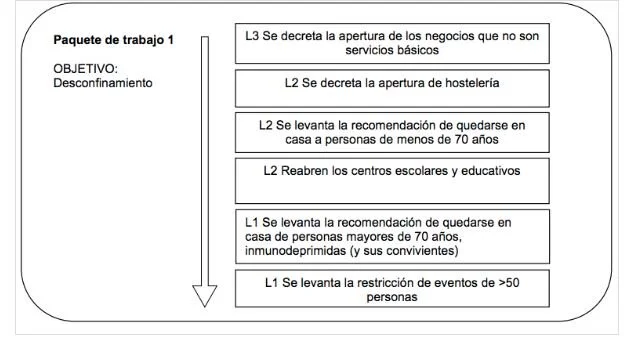
Source: VilaWeb.cat
At the top (L3), businesses that are deemed non-essential would be allowed to open, followed by restaurants; Then (L2) people under 70 would be allowed to leave their homes, and schools and educational centers would then reopen. Among the last measures (L1): people over 70 and those with suppressed immune systems would have the lockdown lifted, and events with more than 50 people would be allowed as well.
As I mentioned at the outset, Spain isn’t out of the crisis yet, not by far. But it is reassuring that this is at least being discussed at the highest levels of our government, which in turn means that the situation, though still grim, has slightly improved.
I thought about the articles I’d read while I was doing the dishes this morning. I scrubbed a pan and imagined our favorite restaurant (amazing croquetas, stellar pinchos) reopening. I stacked dry dishes and cups and felt the first glimmers of hope at imagining being able to see friends again and to be able to pick French class back up. After leaving the house only two or three times in the last month, and always only when absolutely necessary, I dried my hands and smiled at the fact that someday in the future I will once again be able to leave the house without needing to suit up with a mask and gloves (both of which are “highly recommended” in Catalonia as well) and stressing about whether or not I’m unwittingly breathing contaminated air. A return to normalcy, I thought to myself; a return to normalcy is what I want.
But what does “normal” mean now? I keep up with the news coming out of the U.S., and one of the things that I’ve heard more than once is how everyone is wishing to normal. Several timelines have been offered, with some ranging more than 18 months before a vaccine is found and enough people are immunized against COVID-19. A lot of these articles focus on the tangible aspects of a return to normalcy: jobs, social life, etc. all of which are important.
I don’t know about you, but I don’t want to return to the world that we once knew. I want to see my friends and family and swim in the Mediterranean in June, but there’s something that’s just as important.
I want to remember the coronavirus pandemic for the rest of my life. I want to remember the lessons I’ve learned and make the most of the time we’ve been given to process my feelings and do my best to serve as a beacon of light. I don’t want the compassion and closeness I feel to others to fade as the pandemic gradually falls under control. I want us all to remember how important those workers whose jobs seemed “non-essential” to our privileged eyes and that we can give them the living salaries and benefits they deserve. I want this pandemic to end the pointless debate about healthcare not being a human right and for everyone to be able to see a doctor when they need to. I want to fully fund research and to redistribute wealth, because as always, any crisis hits the poor and communities of color the hardest. The list goes on.
Some hope to forget and put this all behind them, but for me, I pray to remember. So that years from now, sitting at a wedding or another celebration, I can tell my nephews what we lived through in that endless winter of 2020, and how we as a global community turned a terrifying and dangerous situation into the catalyst we needed to build a better world.